
Genre: Historical
LGBTQ+ Category: Gay
Reviewer: Ulysses
Get It On Amazon
About The Book
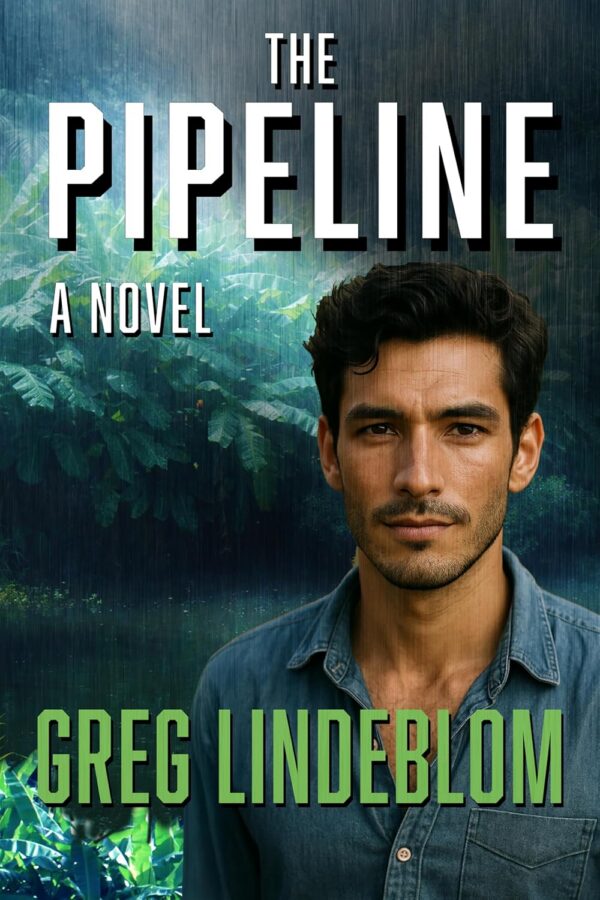
Exiled by his own family for being too visible, too defiant, too himself, Tomás Moreno is abandoned in La Corona—a forgotten jungle town in the far northeastern corner of Colombia. The son of the Minister of the Interior finds himself in a place with no electricity, no running water, and no escape. But in this prison of his family’s making, Tomás discovers something unexpected: purpose.
As teacher, healer, and advocate for the powerless villagers of La Corona, he navigates the impossible space between guerrillas, the oil company, and the military. When rebels repeatedly sabotage the nearby pipeline, toxic oil floods the river that sustains the town, and Tomás becomes the only voice fighting for people who have none.
Then Felix Amaral arrives—a Brazilian engineer working with the cleanup crew—and for the first time in years, Tomás glimpses the possibility of love.
Suddenly, he’s summoned back to Bogotá to join peace negotiations that could end the war. But returning to the family that rejected him means confronting his past. In a land where survival demands compromise and silence, can Tomás claim both love and purpose—or must he sacrifice one to save the other?
A powerful story of love, of identity, of resilience, and of finding family in the most unexpected places.
The Review
I don’t know what inspired Greg Lindeblom to set this novel in the 1990s in Colombia. Clearly, he saw a teaching moment in which to center the romance between Tomás Moreno and Felix Amaral. It’s a remarkable tale, gorgeously told, that presents a dark (and frankly bizarre) tale of survival and redemption. What’s even more remarkable is the joy that surfaces in spite of the darkness.
Tomás Moreno is “disappeared” from Bogota in the middle of the night on orders from his parents. He is dropped off in a tiny, isolated village in the northern jungle along the Catatumbo River. What we don’t quite understand—any more than Tomás himself does—is that this politically-motivated action will indeed change his life; but not in the way his parents expect it to.
Being carried off—wrapped up naked in his bedsheet, bound with duct tape and a black bag over his head—is a terrifying experience. I suspect the author was seeing it as a kind of violent rebirth. He starts out in the village of La Corona with nothing but what clothes he is given by his abductors and the food the villagers bring him. His life is stripped away, because his overt gayness and high public profile embarrassed his powerful political family.
The story eventually jumps to four years later. We learn about his life in La Corona, and about the events that will change it all again—including the appearance of a Brazilian engineer from the big oil company that owns the pipeline that runs along the river by the village.
I never paid much attention to the mess in Colombia in the 1990s—as I’m sure most Americans didn’t. It is a beautiful country beset by political corruption and the competing factions of revolutionaries and drug cartels. All of this creates a complex and rather heartbreaking vision of a nation struggling with its own history while the majority of its population suffers poverty and a general lack of social services. This is the setting for Tomás’s transformation. It is a powerful and emotionally hard-hitting story. It felt particularly appropriate for me to read it at this moment in my own country’s history.
5 stars.
The Reviewer
Ulysses Grant Dietz grew up in Syracuse, New York, where his Leave It to Beaver life was enlivened by his fascination with vampires, from Bela Lugosi to Barnabas Collins. He studied French at Yale, and was trained to be a museum curator at the University of Delaware. A curator since 1980, Ulysses has never stopped writing fiction for the sheer pleasure of it. He created the character of Desmond Beckwith in 1988 as his personal response to Anne Rice’s landmark novels. Alyson Books released his first novel, Desmond, in 1998. Vampire in Suburbia, the sequel to Desmond, is his second novel.
Ulysses lives in suburban New Jersey with his husband of over 41 years and their two almost-grown children.
By the way, the name Ulysses was not his parents’ idea of a joke: he is a great-great grandson of Ulysses S. Grant, and his mother was the President’s last living great-grandchild. Every year on April 27 he gives a speech at Grant’s Tomb in New York City.
