
Genre: Historical, Mystery, Romance
LGBTQ+ Category: Gay
Reviewer: Ulysses
Get It On Amazon
About The Book
“Forgive when there is nothing to forgive, and forget when there is.”
Barbary Fleet, September 1890
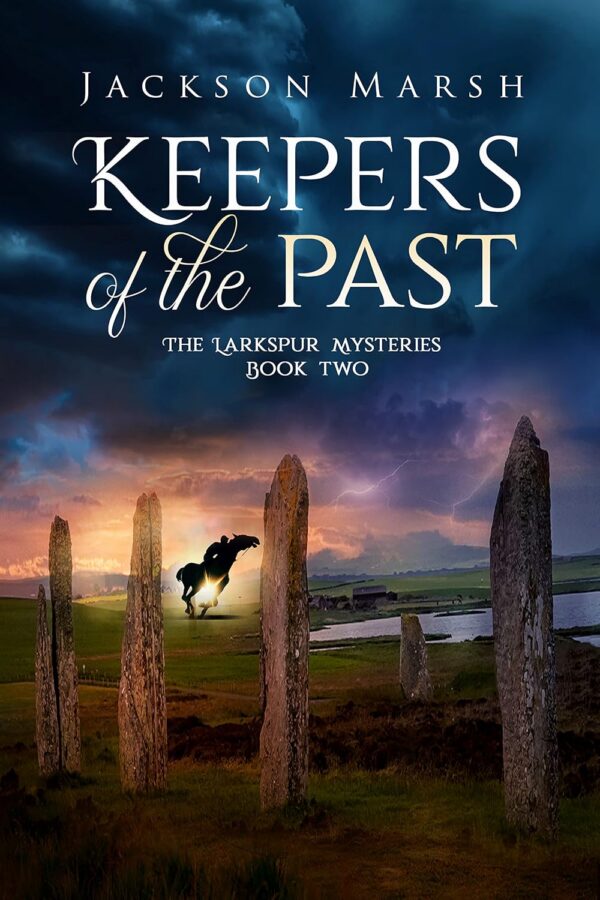
Deaf since birth, Joe Tanner was destined for a life of misery in the workhouse until Lord Clearwater offered him a place at the curious Larkspur Academy in Cornwall. There, while adjusting to his new life, His Lordship challenges Joe to unlock the mystery of the Colvannick stone row.
As Joe sets about his task, he suspects a connection between the standing stones and a series of unsolved murders. The problem is convincing others, and his obsession soon threatens his relationship with his lover, Dalston Blaze. Joe’s determination to unearth the truth also jeopardises his place at the academy, but a man’s life is at stake, and the only one who believes in the mysteries of the past is Joe.
And the killer who prepares to murder his victim and anyone who interferes.
The second of The Larkspur Mysteries continues from book one, ‘The Guardians of the Poor.’ The Larkspur Mysteries are inspired by existing locations and newspaper reports from the time, and combines fact, fiction, adventure and bromance.
The Review
The second of the Larkspur mysteries digs deep into the ancient folklore of Cornwall, where the Clearwater viscounts have lived for centuries. The story of Joe Tanner and Dalston Blaze is at the center of this mystery, and the author explores the emotional complications when two young men, who have only known poverty and limitation previously, have to deal with their utterly changed lives at the Larkspur Academy—the Dowager Lady Clearwater’s former dower house near Larkspur Hall. More than this, is how Joe, with his new freedom and changed social status, deals with feeling both empowered and taken for granted. While he was taunted and brutalized at the workhouse due to his deafness, he is respected and cared for at Larkspur; but he is not, he feels, quite taken seriously.
The knotted emotional tie between Joe and Dalston is underscored when Joe takes on Lord Clearwater’s request to study the carvings on the twelve standing stones that are found on the estate. Because of the language of symbols that Joe and Dalston developed in confinement, Clearwater feels that Joe will be able to help decipher the meanings of the carved stones, standing in alignment with the ruined medieval abbey church. Not only does Joe get profoundly immersed in the history and lore of the various clusters of bronze-age stones scattered around this part of Cornwall, he begins to suspect that they might be linked to the recent unexplained disappearance of a young American.
Unlike the other young men at the Academy House, Joe feels useless, that he’s not doing anything to pay back the comforts and care he’s received from Barbary Fleet, the manager of the academy. In his silent world, Joe doesn’t see things the way his beloved Dalston does, and this leads to heartache and misunderstanding.
The narrative is both an emotionally powerful study of young men’s emotions, and a ripping good mystery that digs deep into actual bronze age history, enriched with the author’s imagination. Without spoiling anything, I can say that the ending was very moving, and utterly satisfying, while leaving enough loose ends to fill at least one further book.
Five stars.
The Reviewer
Ulysses Grant Dietz grew up in Syracuse, New York, where his Leave It to Beaver life was enlivened by his fascination with vampires, from Bela Lugosi to Barnabas Collins. He studied French at Yale, and was trained to be a museum curator at the University of Delaware. A curator since 1980, Ulysses has never stopped writing fiction for the sheer pleasure of it. He created the character of Desmond Beckwith in 1988 as his personal response to Anne Rice’s landmark novels. Alyson Books released his first novel, Desmond, in 1998. Vampire in Suburbia, the sequel to Desmond, is his second novel.
Ulysses lives in suburban New Jersey with his husband of over 41 years and their two almost-grown children.
By the way, the name Ulysses was not his parents’ idea of a joke: he is a great-great grandson of Ulysses S. Grant, and his mother was the President’s last living great-grandchild. Every year on April 27 he gives a speech at Grant’s Tomb in New York City.
