
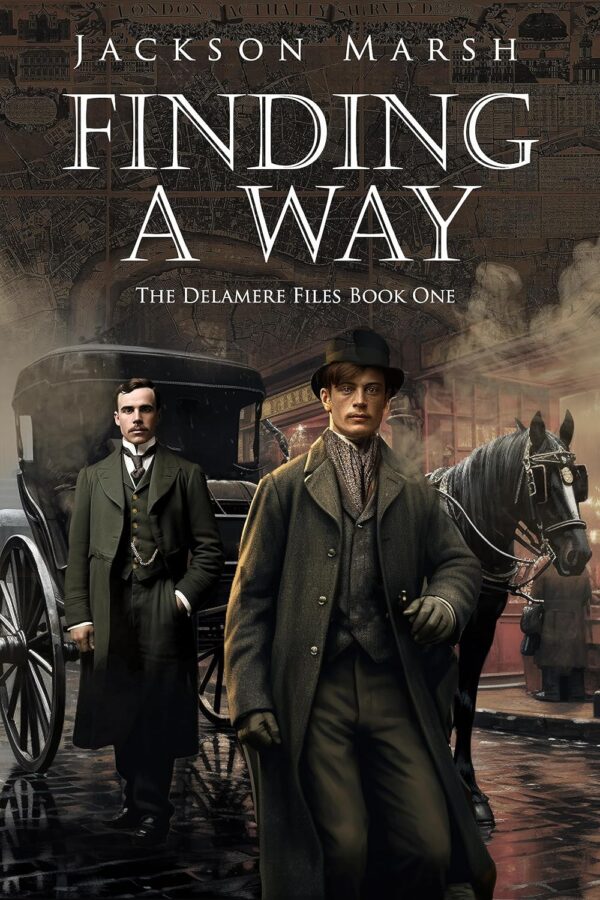
Genre: Historical
LGBTQ+ Category: Gay
Reviewer: Ulysses
Get It On Amazon
About The Book
It began with a man sobbing in the night.
When London cabman, Jack Merrit, falls victim to a ruthless robbery, he believes his world has hit rock bottom. However, a chance encounter with the charismatic writer of social insights, Larkin Chase, offers him a glimmer of hope in the quest for a better life, and love.
Larkin envisions an opportunity for Jack to pocket a handsome twenty-pound reward. The task is simple: identify the nefarious culprits who targeted him. Yet, these criminals are deeply entrenched in the treacherous underbelly of the notorious East End gangland, where witnesses are ruthlessly silenced.
As tempting as Larkin’s proposal sounds, Jack’s once-stable existence begins to unravel. He faces a daunting choice—suppress his forbidden desires or embrace them while pursuing justice and the promised reward. However, Jack’s already complicated life takes another twist with the arrival of a strikingly handsome young detective.
“Finding a Way” marks the beginning of another enthralling Victorian mystery series by Jackson Marsh, author of the acclaimed ‘The Clearwater Mysteries.’ If you delighted in the intrigues of the Clearwater Mysteries and Larkspur Mysteries, this book is sure to captivate you. There is no need to read them first, but it would be a shame to miss out.
The Review
I’ve just discovered this marvelous series and have become an instant fan of Jackson Marsh (aka James Collins) and his Delamere novels.
Set in 1892, “Finding a Way” instantly presents a very different perspective on the Victorian period novel: a close look at the lives of the London cabbies who drove the hansom cabs and new their way through every street and lane of the imperial metropolis. Even today, the familiar black London cab—updated and much improved to suit modern needs—provides the same service with the same skills.
In this London, Larkin Chase, a self-styled journalist and researcher, comes across a cabbie, late at night, sobbing in the shadows. He diplomatically approaches the driver, Jack Merrit, and, offering him a good fare, seeks to find out the source of the cabbie’s grief.
Thus begins a long and complex story of Jack Merrit, his brother Will, and the denizens of London’s Limehouse district—the poor part of the great city, familiar through both Dickens and “Call the Midwife” on BBC; a world away from Larkin Chase’s elegant house and quirky staff. Chase, in his zeal to find truth and right social wrongs, inadvertently drags the Merrits into an ugly world of criminal gangs and corrupt constables. At the same time, Larkin falls for the stoic, handsome, skilled cabdriver, who seems to respond to him in the same way. Jack Merrit is confused at the journalist’s offer of friendship, since it comes from a world he doesn’t understand and taps into feelings he is afraid to acknowledge.
It is 1892, and same-sex relations are illegal (this is just before Oscar Wilde’s notorious fall from grace). As Chase’s involvement with the Merrit brothers turns dark, another character enters the scene, James Wright, an investigator for the Clearwater Detective Agency of Delamere House. Wright makes it clear to the Merrits and to Chase that he and his colleagues are allies—and in more than one way.
One of the most remarkable characters in the story is Will Merrit, who today would be classed as possibly on the autism spectrum, but definitely on the OCD spectrum. In the 1890s he is seen as mentally deficient, but the fact is he’s brilliant. An auto-didact, Will has taught himself about the world through books—borrowed and given within his community. Jack understands his brother and loves him, desperate to protect him from the world. Larkin Chase quickly understands how special Will is, and is forced to deal with Will’s blunt candor and rapid understanding of everything that goes on around him. It’s an extraordinary ingredient in an already fascinating, troubling story.
By the end of this book—which offers a disturbing hook to lead us to the next story—I was thoroughly addicted to the world Marsh has created. There are currently ten books in the Delamere files series, and I suspect I’ll be reading all of them.
5 stars.
The Reviewer
Ulysses Grant Dietz grew up in Syracuse, New York, where his Leave It to Beaver life was enlivened by his fascination with vampires, from Bela Lugosi to Barnabas Collins. He studied French at Yale, and was trained to be a museum curator at the University of Delaware. A curator since 1980, Ulysses has never stopped writing fiction for the sheer pleasure of it. He created the character of Desmond Beckwith in 1988 as his personal response to Anne Rice’s landmark novels. Alyson Books released his first novel, Desmond, in 1998. Vampire in Suburbia, the sequel to Desmond, is his second novel.
Ulysses lives in suburban New Jersey with his husband of over 41 years and their two almost-grown children.
By the way, the name Ulysses was not his parents’ idea of a joke: he is a great-great grandson of Ulysses S. Grant, and his mother was the President’s last living great-grandchild. Every year on April 27 he gives a speech at Grant’s Tomb in New York City.
